
Lost in the Bazaar
US Youth Soccer's Sporting Kluge
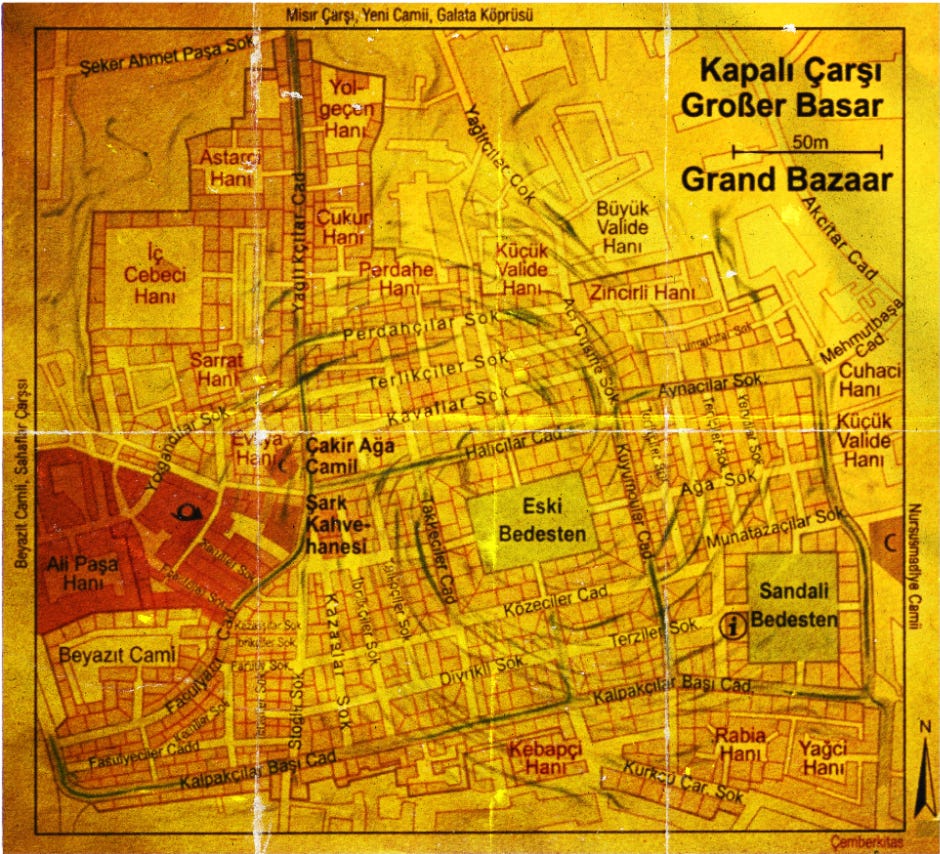
I had been to Turkey before, but never to Istanbul. It reveals itself immediately as a city unlike any other — the point where Europe tips into Asia, where the Hagia Sophia and the Blue Mosque face each other across centuries. And then there is the Bosphorus, carrying tankers between two continents and making the whole arrangement feel provisional, as if the city is still deciding which world it belongs to. I’d read about the Grand Bazaar. I thought I knew what I was walking into.
Within sixty seconds of passing through the Beyazıt Gate I was lost.
This is, I later learned, not a failure of navigation. It is the point. The Bazaar is not designed to be navigated — it is a living system, evolved over five hundred and seventy years through thousands of small decisions made by guilds, merchants, and ordinary people trying to make a living in an extraordinary place. Its sixty-one streets and four thousand shops arrange themselves around the logic of trade and proximity, each vendor responding to his neighbors, the whole emerging into something neither chaotic nor controlled.
What struck me, once I stopped trying to find my way and started paying attention, was something the guidebooks mention only obliquely. Everything in the Bazaar presents itself with identical confidence. The copper worker and the vendor selling “authentic replica” Louis Vuitton bags occupy the same light, use the same gestures, speak with the same authority. There is no visible signal that separates the real and what is merely performing authenticity.
The Bazaar did not drift into this condition. It arrived here through a sequence of institutional changes. The original guild system, the lonca, was designed to provide a signal: guilds controlled quality, membership, and price. The certificate meant something because the guild stood behind it. But over time a system called the gedik emerged: licenses that could be bought and sold, traded in ways that detached them from the craft they were supposed to certify. People with no artisan background purchased their way into guilds. Certificate and competence were separated. After the guilds dissolved entirely in the early twentieth century, shopkeepers gained full autonomy over what they sold and where, and the market filled with everything — genuine and counterfeit — presented with equal confidence.
To know the difference you need either deep expertise or a trusted guide.
We returned home from Turkey to find that my son’s U13 team had disbanded. Not because the kids had lost interest. Not because there weren’t enough players. The team disbanded because the coach was not permitted to stand on the touchline during matches. The new rule required game-day coaches to be parents of players on the team.
I won’t go into how he came to be in a town of six thousand in Northern California. Only that he was there — a coach with genuine EPL academy experience, a real feel for the game and for the kids in front of him. He was, in the language of the Bazaar, the real thing — and the system had no place for him.
And so I found myself inside US youth soccer, looking for a club for my son.
From a distance it looks exactly like what it claims to be: the infrastructure of a sporting nation finally serious about the world’s game, vast, intricate, and impressively alive.
Step closer and walk in. I was back at the Beyazıt Gate. Clubs with names that evoke European prestige. Leagues. Credentials. Pathways. All speaking with identical confidence.
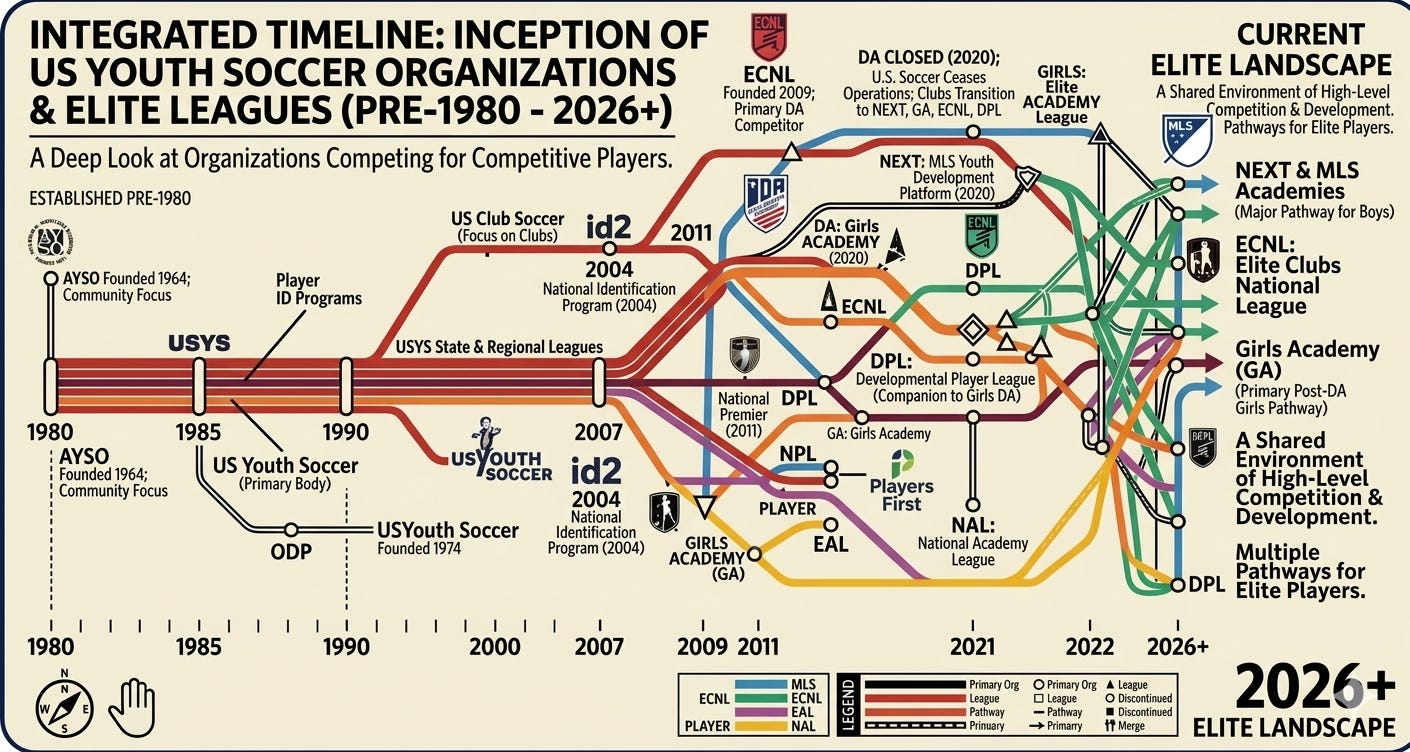
From a distance it looks coherent. Up close it is a sporting kluge, accumulated rather than designed, held together by thousands of local actors — clubs, leagues, coaches, state associations, regional federations — each responding to its immediate environment.
Every club has a “philosophy.” Every club has a “way.” Every club has a list of players who went on to play college soccer, and the suggestion that the journey to professional football starts here. As far as I can tell, only one player from an area of roughly half a million people has reached the professional level in the last decade. The websites do not mention this. What they sell is not probability. It is proximity to possibility — the idea that progress begins here, and is available to anyone willing to commit. And of course, to pay.
Trials for all the clubs happen in the same week. If an offer is made, the player and family have twelve hours to accept or it is withdrawn. Acronyms—ECNL, MLS NEXT, GA, ODP—multiply faster than they can be learned. Each competition format comes with its own tier structure and its own ‘national identification’ pathway, each suggesting that this specific combination of letters is where serious football begins.
Where language fails, infrastructure steps in. Three sessions a week, plus a fourth club-wide strength and conditioning day. Weekend travel that routinely exceeds the minutes your child will actually play. The tournament culture has children playing five games in a weekend in the name of development, which is the opposite of development. Ninety percent attendance expected.
And if that does not work, there is always the next layer: the uniforms. Two game jerseys. Three training jerseys. Two pairs of shorts and socks. A club tracksuit — optional, in the way that things are optional when everyone else has one. Adidas or Nike, of course; anything else would feel like the wrong signal. Somewhere in this logic, seriousness becomes something you can wear, a cue aimed at parents who were not raised in the game. The swoosh becomes a proxy for program quality, in some cases more than the club crest over the heart.
When language and infrastructure stop being enough, technology takes over. Tracking cameras line the touchlines. Video platforms record every poorly controlled ball and mishit pass. You are always being evaluated. Seriousness is a performance for an audience that never leaves.
I work in the game. None of it helps me distinguish one club from another, or one development pathway from the next. If anything, the sameness becomes more obvious the longer you look — the repetition of phrases, the uniform confidence, the absence of friction between what is claimed and what is real.
The offers came anyway. Two separate clubs, two different pathways, two promises of professionalized seriousness. We let the clocks run out.
He went and played rec. That’s where his friends are.
Coda
Football is a game of numbers. Ninety minutes. Seventeen laws. Eleven players aside. Two halves. One winner.
Increasingly, it is also a game of data — possession, xG, load metrics, probabilities layered on probabilities.
And now, a game of valuation. Top European clubs trade at revenue multiples once associated with technology companies. The game is measured in broadcast figures, engagement metrics, projected growth curves, and discounted future earnings. At those valuations, an executive is no longer simply managing a club. He is managing an asset. Yet the game remains the underlying reality. Whether it is still worth watching is the one thing that cannot be reduced to a number.
But there are two numbers I keep coming back to, and you will not find them on Transfermarkt, Stats Perform, or any executive dashboard.
Fewer than one per cent of academy players will ever play professional football. According to Michael Calvin, author of No Hunger in Paradise, only 180 of the 1.5 million players in organised youth football in England at any one time will make it as a Premier League professional. A success rate of 0.012%. Roughly the odds of being struck by a meteorite on the way home.
To commit to the game as a career is a risk. It pays off — in the sense of providing a career worthy of the name — for only a tiny minority. And only a minority of that minority will make the fabulous riches people imagine when they think of it. It is a precarious gamble.
The second number is less visible, and it has nothing to do with football.
By the time a child turns eighteen, around ninety per cent of the time you will ever spend with them has already passed.
Taken together, these numbers describe a system organised around the wrong calculation. Youth football runs on the logic of the long tail: the improbable outcome that justifies everything that comes before it. Somewhere, a child will emerge and sign a professional contract. That story is real. It is also statistically irrelevant to almost everyone inside the system.
And yet the entire structure — the language of pathways, the commitments, the travel, the kits, the weekends, the branded tracksuits, the constant signaling of seriousness — is organised around the extraction of value from families, dressed in the language of the children’s best interests.
There is a quality to finite experiences that only becomes visible in retrospect. We are always living through endings realising only later which moments were the last of their kind. The last time they held your hand to cross the road. The last time they asked you to push them on the swings. Childhood is made of these quiet disappearances. So is family life.
Which leaves an uncomfortable question: not whether the system produces professional footballers, but what it quietly removes in the pursuit of them.
Children play football. They do not work football.
Somewhere between the Beyazıt Gate and a Tuesday evening U13 trial session in Northern California, I stopped being sure the system knows the difference.
About the Author: James Easton is a former Canadian international who played professional football on three continents. He has worked at the intersection of sport, economics, and political geography, and writes about the game as a lens on power, institutions, and the stories we tell to sustain them.
this...100x this...